💣 Minesweeper
🧩 Puzzle · 38 playsMinesweeper
Numbers tell you where the mines are. Deduce, flag, clear.
About Minesweeper
A logic puzzle disguised as a game of nerves. Uncover squares one at a time; each number tells you how many mines sit in the eight squares around it. From that you can work out, with certainty, where every mine is hiding — no guessing required if you read the board carefully. Three board sizes, a first click that is always safe, and long-press flagging that works on a phone.
How to Play
Tap to reveal a square. The number is the count of mines touching it. Long-press (or right-click) to flag a mine. Reveal every safe square to win. Your first tap never hits a mine.
💡 Tips & Strategy
A number touching exactly that many hidden squares means every one of them is a mine — flag them. A number that already touches that many flags means the rest are safe — open them. Those two rules solve most of a board.
Work the edges and corners first; they have fewer neighbours, so the logic is tighter.
When a 1 and a 2 sit side by side, the squares only the 2 touches often hold the extra mine. Look for those patterns before you consider guessing.
What the three boards really ask of you
The sizes here are the classic ones. Easy is 9 by 9 with 10 mines, Medium is 16 by 16 with 40, and Hard is 16 by 30 with 99. The jump in difficulty is bigger than the mine counts suggest, because what matters is density: about 12% of Easy’s squares are mines, about 16% on Medium and about 21% on Hard. At 21%, numbers crowd together, open zero areas shrink, and you spend far more time on tight logic and forced guesses.
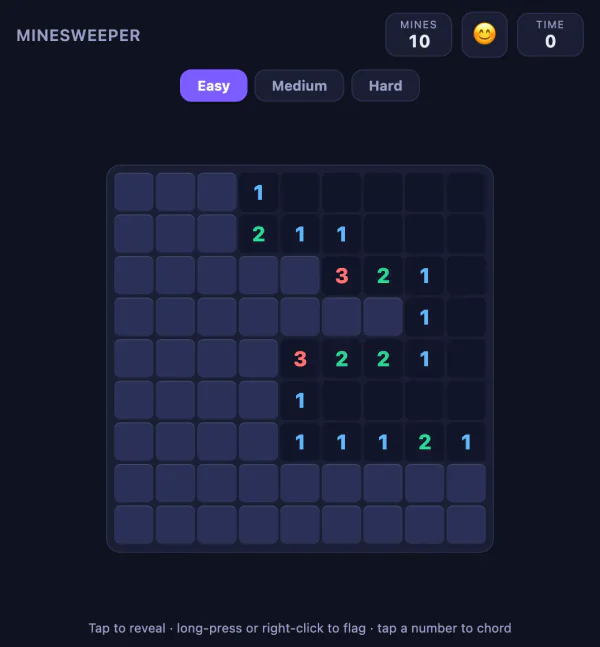
Your first tap is protected more generously than the How to Play line implies. The game places the mines only after that tap, and it keeps both the square you tapped and all eight squares around it clear. So your first square is always a blank zero, and the board always cascades open a patch for you to start reading. Tap near the middle on Easy and Medium for the biggest opening; on Hard any interior square works the same way.
Controls that save you seconds
Tap or click a hidden square to open it. Right-click on a computer, or hold your finger on a square for about a third of a second on a phone, to plant or remove a flag. Flags are optional: you win the moment every safe square is open, and the game flags any leftover mines for you.
The big time-saver is the chord. Tap a number that is already open, and if you have placed exactly that many flags around it, every other hidden neighbour opens at once. If the flag count does not match, nothing happens, so a mis-tap is harmless. The catch: chording trusts your flags completely. One wrong flag next to that number and the chord opens a real mine. When you lose, wrongly flagged squares are shown with a cross, which is the quickest way to learn where your logic slipped.
The mine counter is simply total mines minus flags placed. It does not check whether your flags are right, and it will happily go below zero if you over-flag, which is a useful alarm that something is wrong.
Patterns worth memorising
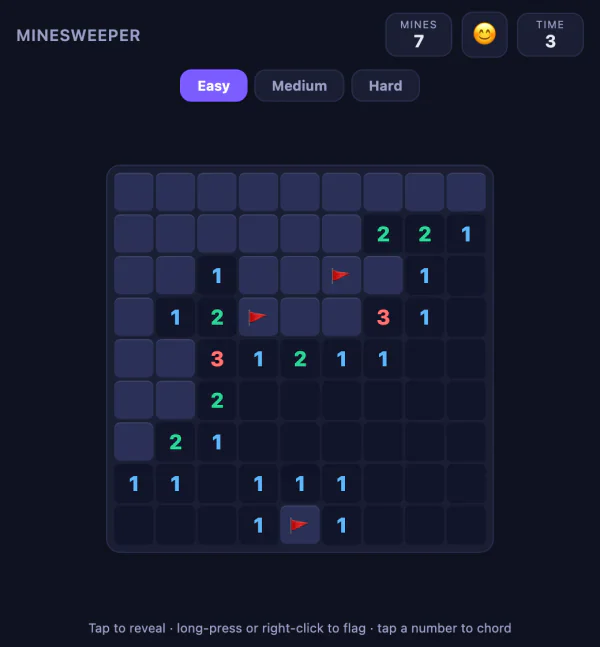
Once the two basic rules stop giving you moves, look for these shapes along a straight edge of open numbers with a row of hidden squares beyond it. Each one is pure deduction, not luck.
- 1-2-1: the mines sit beside the 2, directly beyond each 1, and the square directly beyond the 2 is safe. If that middle square were a mine, both 1s would be full, leaving the 2 with only one mine.
- 1-2-2-1: the mines sit directly beyond the two 2s, and the outer squares beyond both 1s are safe.
- 1-1 starting at a wall: the first 1 can only see two hidden squares, and its mine is one of them. The second 1 sees those same two plus a third, so that third square is safe.
- A 1 touching just one hidden square: that square is a mine. Obvious, but it is the anchor that unlocks most of the patterns above.
- Subtraction: if a 3 shares two of its hidden neighbours with a 1, at most one mine sits in the shared pair, so at least two of the 3’s mines must be in the squares the 1 cannot see.
Beginner mistakes that cost games
Guessing too early is the big one. Before you tap a square you are not sure about, sweep the whole frontier again, including corners you have not looked at for a while. A stalled area often unlocks from the other side of the board.
Flag-then-chord on a hunch is the second. A flag you placed because a square felt likely is a guess dressed up as a fact, and the chord will act on it.
The third is forgetting the counter in the endgame. With 3 hidden squares and 1 mine left, a pattern that looked like a coin flip can become certain, because only one arrangement uses exactly the mines remaining.
When you truly have to guess
Some boards contain positions no amount of logic can settle, such as two hidden squares sharing a single mine with nothing else touching them. That is a genuine 50/50, and no technique changes it. Take it early, while you have little invested, rather than leaving it for last.
If you must guess elsewhere, compare odds. A square next to a 1 with four hidden neighbours is roughly a 1 in 4 risk. A square far from any number carries roughly the overall density of what is left: remaining mines divided by remaining hidden squares. Prefer guesses that, if safe, are likely to reveal information, such as a square that could be a zero and open a fresh area.
Scoring and best times
A loss scores 0. A win scores 1000 minus your time in seconds, with a floor of 100, multiplied by 1 on Easy, 2 on Medium and 3 on Hard. Clear Easy in 60 seconds and you get 940. Clear Hard in 300 seconds and you get 2,100. The clock starts on your first tap or first flag, and your best time for each difficulty is kept on your device and shown on the end screen.
If you leave mid-game, your board and clock are saved, so you can close the tab and pick up exactly where you were. Tapping the smiley face, or switching difficulty, starts a fresh board and discards the saved one.
Minesweeper FAQ
Is every Minesweeper game solvable without guessing?
No. Mines here are placed at random after your first tap, with no check that the board can be solved by logic alone. Most Easy boards can be, but on Hard you will regularly meet a forced guess, often a 50/50 near a wall or in a corner.
Can I lose on my first click?
Never. Mines are placed after your first tap, and that square plus its eight neighbours are always kept clear, so your first square is guaranteed to be a zero that opens an area.
What does chording mean in Minesweeper?
Tapping an opened number whose flag count already matches it. Every other hidden neighbour then opens at once. It is fast, but if one of those flags is wrong you open a mine.
Do I have to flag every mine to win?
No. You win as soon as every safe square is open. Flagging is only there to help you keep track and to make chording possible.
Why are the board sizes 9x9, 16x16 and 16x30?
They are the traditional Beginner, Intermediate and Expert boards from the version of Minesweeper that shipped with Microsoft Windows, and they are the standard sizes people use when comparing times.
Is there an undo or hint button?
No. This version has no undo and no hints. Every tap is final, which is exactly why the patterns and the habit of rechecking the whole frontier matter so much.