🧠 Pair Up
🧩 Puzzle · 50 playsPair Up
Flip two cards at a time and find every matching pair.
About Pair Up
A memory workout that is also just pleasant to play. All the cards start face down; flip two, and if they match they stay up. If not, remember where they were and try again. Fewer flips and a faster clock mean a better score, and three grid sizes let you pick anything from a quick round to a proper test of recall.
How to Play
Tap a card to flip it, then tap a second one. A match stays face up. A miss flips back — remember it! Clear the board in as few moves as you can.
💡 Tips & Strategy
Turn cards over in a fixed order — row by row — instead of at random. Then, when a card comes up, you already know where its partner might be from earlier flips.
Say the emoji to yourself as you see it. Naming things fixes them in memory far better than just looking.
When the first flip shows a card you have already seen the twin of, go straight to it. When it is new, pick a card you have never flipped for the second — you learn more that way.
What happens on every turn
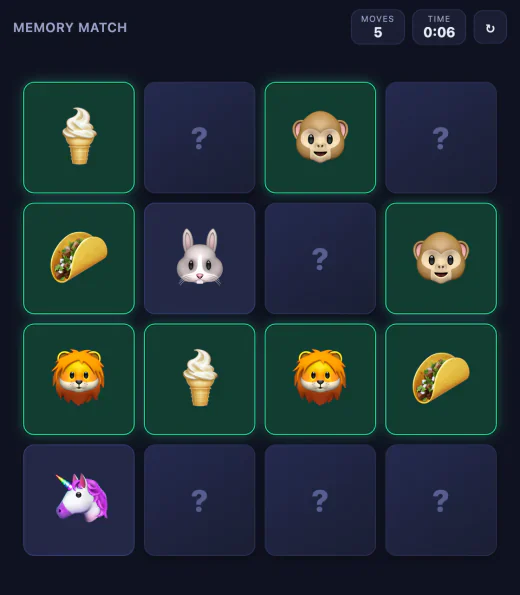
Pick a board and every card lands face down. Tap one, then a second. If they show the same emoji, both lock face up with a green glow. If not, they wobble and flip back after a beat, and the board ignores your taps until they have turned over, so there is no rushing a third card in.
A move is one pair of flips, not one card. Revealing two cards costs exactly one move whether they match or not. The clock starts on your very first tap, not when the board appears, and it stops the instant the last pair locks. There is no lose condition and no move limit: every round ends in a win. The only question is how clean it is.
Pick your board
The pictures come from a pool of 20 emoji, ten animals and ten foods, and each round draws a fresh random set, so you will almost never see the same layout twice.
- Easy, 4 by 3: 12 cards, 6 pairs. A warm-up you can clear in under a minute.
- Medium, 4 by 4: 16 cards, 8 pairs. The classic size, and the one where real tracking starts.
- Hard, 6 by 5: 30 cards, 15 pairs. Fifteen of the twenty emoji are in play, so near-lookalikes like the cookie and the doughnut often share the board.
How your score is worked out
Your score is 1,000, minus 10 for every move, minus 2 for every second on the clock, and it never drops below 100. One wasted move costs the same as five seconds of thinking, so accuracy beats speed. Pausing for a couple of seconds to recall where the fox was is a bargain if it saves a miss.
Worked example: clear Medium in 14 moves and 45 seconds and you score 1,000 minus 140 minus 90, which is 770. Rush it in 30 seconds but take 20 moves and you get 1,000 minus 200 minus 60, which is 740. Slower and sharper wins.
The theoretical ceiling is one move per pair, which only happens with pure luck. With perfect memory and smart play you should expect roughly 1.6 moves per pair, so about 10 moves on Easy, 13 on Medium and 24 on Hard. Hit those and you are playing as well as recall allows. Your best score is saved separately for each board size, in this browser on this device.
Mistakes that cost you points
Since every round ends in a win, points are lost to wasted moves and idle seconds, and these four habits waste the most.
- Flipping a known card second just to look busy. If your first card is new and you have not seen its twin, the second flip should also be a card you have never seen. Re-flipping a known card teaches you nothing.
- Forgetting the free match. When your second flip reveals the twin of a card you saw earlier, you cannot claim it this turn, but next turn it is a guaranteed pair. Take it immediately, before newer cards crowd it out of your head.
- Rotating your phone mid-round. The board re-fits itself to the screen and can switch between, say, 6 columns and 5, which reflows every card into a new position. Everything you memorised is suddenly wrong. Lock your orientation before you start.
- Hitting the restart arrow to escape a bad start. It sends you back to the board menu and wipes the round, and the new board starts from zero knowledge, so you lose everything you have already learned about this one.
Strategy for the bigger boards
On Hard you will see a dozen or more cards before most pairs are possible, and raw recall starts to leak. Split the board into zones: left half and right half, or top rows and bottom rows. Remember each card as "pizza, top right zone, second in" rather than as an exact coordinate. Zones are easier to hold than thirty separate spots.
Use the two families. Ten animals and ten foods means you can store a rough map like "foods clustered bottom left" while you hunt. When a food card turns up, you already know which side of the board to search.
Count what is left. When only two pairs remain and you know one card, the endgame is mechanical. And when one pair remains, you know exactly where both cards are by elimination, so that last move is always a match. Do not let a late slip cost you there.
Where the game comes from
Pair Up is a version of the old card game usually called Concentration, also known as Memory, Pairs or, in Britain, Pelmanism, after the Pelman memory-training system. It is traditionally played with a full deck of playing cards laid face down, matching ranks. The name Concentration was also borrowed by a long-running American TV game show built around the same idea of hidden matching panels.
Pair Up FAQ
How is the Pair Up score calculated?
Start at 1,000, subtract 10 per move and 2 per second, with a floor of 100. A move is one pair of flips, so a 12-move, 40-second Medium round scores 1,000 minus 120 minus 80, which is 800.
What is a good number of moves in a memory matching game?
With a perfect memory and good play, expect about 1.6 moves per pair on average. In Pair Up that is roughly 10 moves on Easy, 13 on Medium and 24 on Hard. Matching the pair count exactly, 6, 8 or 15, takes luck as well as skill.
Can you lose at Pair Up?
No. There is no move limit and no time limit, so every round ends with the board cleared. What changes is your score, which falls with every extra move and second until it bottoms out at 100.
Does the timer start before I flip a card?
No. The clock only starts on your first tap, so take a breath before you begin. It stops as soon as the final pair matches.
Why did my cards move around?
The board resizes to fit your screen. If you rotate your phone or resize the window, it may change how many columns it uses, and every card shifts to a new spot. Keep the screen still during a round.
Is my best score saved?
Yes, one best per board size, stored in your browser on this device. Clearing site data or switching to another browser or phone starts you fresh.