9️⃣ Sudoku
🧩 Puzzle · 43 playsSudoku
Fresh 9×9 puzzles from easy to expert, with notes and a timer.
About Sudoku
The number puzzle that needs no maths, only logic. Fill the grid so that every row, every column and every 3×3 box holds the digits 1 to 9 exactly once. Each puzzle here is generated on the spot with a single guaranteed solution, and four difficulty levels take you from a gentle warm-up to the sort of board that takes a whole lunch break. Pencil notes, mistake counting and a timer are built in.
How to Play
Tap a cell, then tap a number to place it. No repeats in any row, column or 3×3 box. Switch on Notes to jot candidates. Harder levels end after three mistakes.
💡 Tips & Strategy
Start with the digits that already appear most often — if six 7s are placed, the last three are usually forced. Scan each 3×3 box for the one cell a digit can still go in.
Use notes as soon as the easy placements dry up. A cell with only two candidates, or a digit with only two possible cells in a row, is where the next move hides.
Never guess. Every puzzle here has one solution that can be reached by logic alone, and a guess that goes wrong costs one of your three mistakes on the hard levels.
What the four levels really change
Every board starts as a complete, valid 9×9 grid. The game then removes digits one at a time, and after each removal it checks that the puzzle still has exactly one solution. If taking a digit out would allow a second answer, that digit goes back. So whatever level you pick, the answer is never ambiguous.
The levels differ in how many digits you start with and how forgiving the game is.
- Easy: aims for 38 starting digits, unlimited mistakes.
- Medium: aims for 32 starting digits, unlimited mistakes.
- Hard: aims for 27 starting digits, and the third mistake ends the game.
- Expert: aims for 23 starting digits, same three-mistake limit.
How this version checks your answers
The game knows the solution from the first second, and it checks every digit you place against it straight away. A wrong digit turns red and adds one to the mistake counter. A right digit locks in place: you can’t erase it or overwrite it, so a correct cell can never be undone by a slip of the finger.
Typing the same wrong digit into the same cell again does not count as a second mistake. Notes never count as mistakes, however wrong they are. And when you place a correct digit, that digit is wiped from the notes of every cell in the same row, column and box, so your pencil marks tidy themselves up as you go.
The number pad counts how many of each digit you still need. Tap a filled cell and every matching digit lights up. On a keyboard, 1 to 9 places a digit, the arrow keys move around, N switches notes on and off, and Backspace, Delete or 0 clears a cell.
There is no hint button and no undo. The puzzle saves itself as you play, notes and clock included. Your best time is kept separately for each level, in this browser on this device.
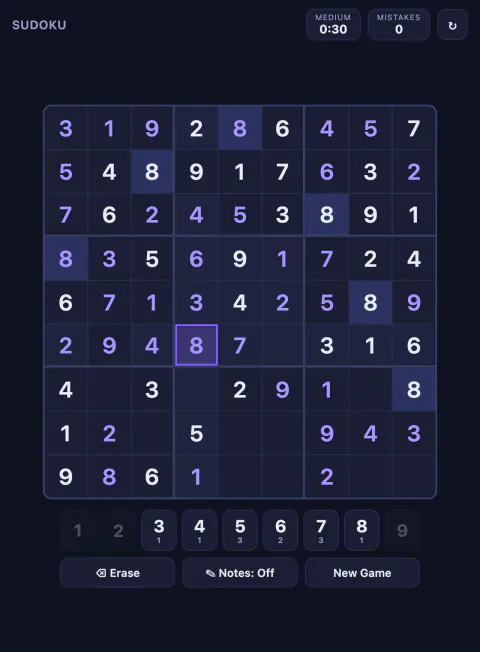
A worked example: the hidden single
The tips above tell you to scan boxes. Here is what that looks like on a real board. Say you are looking at the top-left box and want to know where its 5 goes. There is a 5 in row 1 further along to the right, so the 5 can’t be anywhere in the top row of the box. There is another 5 in row 3, over in the top-right box, so the bottom row of the box is out too. That leaves the three cells in row 2. Now look down the columns: a 5 sits in column 1 lower on the board, and the middle cell of row 2 already holds a 7. Only one cell is left. That is the 5, and you didn’t need a single note to find it.
Repeat that for every digit in every box and most of an Easy board falls. When a full sweep finds nothing, start writing notes.
Moves that crack Hard and Expert
With 27 or 23 starting digits, single-cell scanning stalls quickly. These patterns are what move you forward. Each one rules out candidates, which usually sets up the next easy placement.
- Naked pair: two cells in the same row hold only the notes 3 and 8. One gets the 3 and the other gets the 8, so you can delete 3 and 8 from every other cell in that row. The same works in a column or a box, and with three cells sharing three digits.
- Pointing pair: inside one box, the only cells that can hold a 4 both sit in the same row. Whichever one gets it, that row’s 4 is inside this box, so cross 4 off the rest of that row outside the box.
- Box-line reduction: the reverse. If a row’s only spots for a 6 all fall inside one box, the 6 for that box must be in that row, so remove 6 from the box’s other cells.
- X-Wing: a 2 can only go in columns 3 and 7 in row 2, and only in columns 3 and 7 in row 8 as well. Those four cells form a rectangle and the two 2s must sit on opposite corners, so columns 3 and 7 are covered. Delete 2 from every other cell in those two columns.
Beginner habits that cost mistakes
On Hard and Expert you get three mistakes, so the habits that were harmless on Easy suddenly decide whether you finish.
- Trying a digit to see if it turns red. It works, but each red digit is a mistake, and on Hard that is a third of your budget gone.
- Noting every cell at the start. Make the obvious placements first and you will have far fewer candidates to manage.
- Checking only the row and column. The box is the rule people forget most, and it causes most wrong placements.
- Leaving a red digit on the board. It sits there making peer cells look full. Clear it with erase before you carry on.
Scoring and times
Your result is about speed and accuracy. A solved puzzle scores 1,000 minus one point per second on the clock, minus 50 for every mistake, and it never drops below 100. Finish a Medium in 6 minutes and 40 seconds with one mistake and you get 1,000 minus 400 minus 50, so 550. Losing on the three-mistake limit scores 0.
That makes one mistake worth the same as 50 seconds. When unsure, half a minute of notes beats a guess.
Where Sudoku comes from
The puzzle first appeared in American puzzle magazines in the late 1970s under the name Number Place. It picked up the name Sudoku in Japan, where the publisher Nikoli made it popular in the 1980s, and it spread to newspapers around the world in the mid-2000s. There is no maths in it: the digits are just symbols, and nine letters would work as well.
Sudoku FAQ
Does every Sudoku have only one solution?
A properly made one does, and every puzzle here does. The generator removes digits only while it can confirm the board still has exactly one answer, so you can always solve it by logic, with no guessing.
What is the fewest starting numbers a Sudoku can have?
Seventeen. A computer search published in 2012 showed that no 9×9 puzzle with 16 clues has a unique solution. The hardest level here, Expert, aims for 23.
Is more clues always easier?
Usually, but not always. Difficulty depends on which solving techniques a puzzle needs, not just how many clues it has. On this site the level sets the number of clues, so now and then an Easy board solves itself in minutes and a Medium needs a pair or two.
Why can’t I erase a number I placed?
Because it’s correct. The game locks every right digit so you can’t erase it by accident. You can only erase digits that are wrong, which show in red.
Do wrong notes count as mistakes?
No. Only digits you place outside Notes mode are checked. Pencil marks are yours to use however you like, so use them freely on Hard and Expert.