🔢 2048
🧩 Puzzle · 95 plays2048
Slide, merge, double. Can you build the 2048 tile?
About 2048
Four rows, four columns, and a very simple rule: slide everything one way and any two tiles with the same number that bump into each other become one tile of double the value. 2 becomes 4, 4 becomes 8, and if you keep your head you will reach 2048 — the point where most people finally stop saying "one more go". Keep your biggest tile in a corner and you will get a lot further than you expect.
How to Play
Swipe (or use the arrow keys) to slide every tile at once. Matching tiles that collide merge into one. Make a 2048 tile to win — or keep going for a higher score.
💡 Tips & Strategy
Pick a corner and keep your biggest tile there. Only ever use three directions — down, left and right, say — and treat the fourth as an emergency exit. That alone doubles most people's scores.
Build along one edge in descending order, like a snake: 512, 256, 128 in a row. Then merges flow toward the corner naturally instead of scattering.
When the board fills, slow down. One careless swipe that lifts the big tile off its corner is how nearly every game ends.
Exactly how a move works
Every swipe moves all sixteen squares at once. Each tile slides as far as it can in that direction, and when it runs into a tile with the same number, the two fuse into one tile worth double. Then a single new tile drops into a random empty square: a 2 nine times out of ten, a 4 the other one time.
Two details decide a lot of games. First, a tile can only merge once per move. Second, the tiles nearest the wall you are pushing toward merge first. So a row of 2, 2, 2, 2 swiped left becomes 4, 4 rather than 8, and a row of 2, 2, 2 swiped left becomes 4, 2 with the leftover 2 on the far side. Plan with that in mind and you will stop being surprised by where the odd tile ends up.
One more thing worth knowing: if a swipe would not move or merge anything, nothing happens at all. No new tile appears and the turn is not used up. You can tap a direction you think is blocked without any penalty.
Scoring, with real numbers
Your score goes up by the value of every new tile a merge creates. Two 2s make a 4 and earn 4 points. Two 512s make a 1024 and earn 1,024. Sliding tiles around without merging earns nothing.
Because big tiles are built from smaller merges, points stack up fast. A 2048 tile built entirely from spawned 2s is worth about 20,480 points in total once you count every merge that went into it. Spawned 4s skip the first merge, so in practice a game that reaches 2048 usually lands somewhere around 18,000 to 20,000. If you hit 2048 with a much lower score, that is normal luck with 4s, not a scoring bug.
Your best score is saved in your browser on this device, so it survives a refresh but will not follow you to a different phone or browser.
Beginner mistakes that end games early
Most early losses come from the same handful of habits. Fix these before worrying about anything clever.
- Swiping in circles. Rotating up, right, down, left feels productive and scatters your big tiles across all four walls.
- Chasing every merge. Merging two 8s in the middle of the board is worth less than keeping your edge row tidy.
- Pressing the fourth direction casually. With a corner strategy, one stray swipe pulls your biggest tile out and drops a 2 into the corner behind it.
- Letting small tiles get trapped. A lone 2 stuck between a 64 and a 256 on your main edge can block that row for a dozen moves.
- Playing fast on a full board. When only two or three squares are empty, every move matters. Slow down.
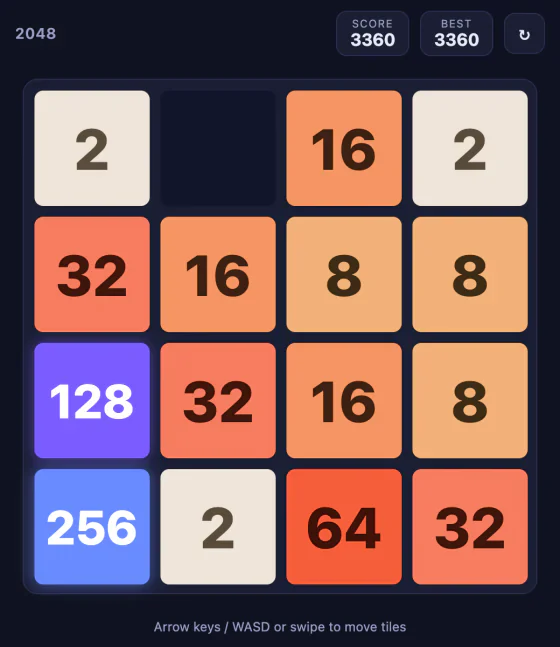
The snake: building a chain that merges itself
Say your 256 sits in the bottom-left corner and you only swipe down, left and right. Fill the bottom row so it reads 256, 128, 64, 32 from left to right. The row above continues the pattern back the other way, so the chain snakes: a 16 sits directly above the 32, with smaller tiles running off to the left. Turn that 16 into a 32, drop it onto the 32 below, and a short run of left swipes rolls the chain home: 64 meets 64, 128 meets 128, 256 meets 256, and a 512 lands in your corner.
The key is keeping the bottom row full. A full row with no matching neighbours cannot shift sideways, which means left and right swipes only move the rows above it. That is what keeps your 256 locked in its corner while you build.
If the bottom row has a gap and you must use the forbidden direction, wait until it is the only legal move, and immediately swipe back toward your corner on the next turn. The new tile that drops into the empty corner is usually a 2, and a fast swipe often pushes your big tile straight back.
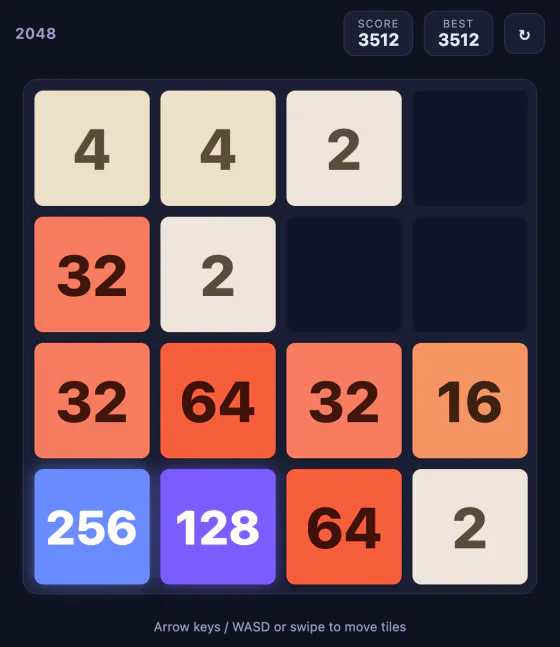
Advanced situations
Two equal big tiles on your edge, not touching, is the classic stall. If you have 128 in the corner and another 128 two squares along with a 16 between them, do not build a fresh 128 elsewhere. Grow that 16 into a 128 in place, or clear it, so the three merge in sequence. Feeding the tile closest to the gap is almost always faster than starting a new chain.
Count empty squares before each move. Each move adds exactly one tile, and each merge removes one. If your next move merges nothing, you are down one square. When you are below three empty squares, choose the move that merges the most, even if it looks messy, because breathing room beats tidiness.
Watch the second row. Late in a game the bottom row is mostly locked, and the real game happens one row up. Keep that row flowing in the snake direction and avoid parking a big tile there that has no matching partner coming.
After 2048: keep going or start fresh
The win screen appears the moment you first create a 2048 tile. You can press Keep going and carry on with the same board and score, or start a new game. Tiles above 2048 keep doubling: 4096, 8192, 16384 and beyond. Your run ends only when the board is full and no two neighbouring tiles match, at which point you get the game over screen with your final score.
If you keep going, expect the board to feel tighter. A 2048 tile plus a working chain of 1024, 512, 256 and 128 already uses five of your sixteen squares, so the snake discipline matters even more.
Where 2048 came from
The original 2048 was made by Italian developer Gabriele Cirulli and released as a free open-source web game in March 2014. It drew on earlier sliding-tile games such as 1024 and an earlier mobile number-merging hit, and it spread across the internet within weeks, spawning countless clones and variants. This version plays the classic 4 by 4 rules.
2048 FAQ
What is the best strategy for 2048?
Keep your biggest tile in one corner, use only three directions, and keep the edge row next to that corner full and in descending order. That single habit gets most players from stalling at 512 to regularly reaching 2048.
Is 2048 pure luck?
No. New tiles appear in random empty squares and are a 2 nine times in ten or a 4 one time in ten, so luck plays a part. But strong strategy reaches 2048 in most games, while random swiping almost never does.
What is the highest tile possible in 2048?
On a 4 by 4 board the theoretical maximum is 131,072, which needs every square filled with a perfect descending chain and a lucky 4 at the end. In practice, 4096 or 8192 is an excellent result.
Can I undo a move?
Not in this version. Every move is final, which is why slowing down when the board is nearly full matters so much. The restart button starts a fresh game whenever you want.
How do I play 2048 on a keyboard or phone?
On a computer use the arrow keys or W, A, S and D. On a phone or tablet swipe anywhere on the board; a very short flick is ignored, so make each swipe a clear stroke in one direction.
Why did two tiles not merge when I expected them to?
Each tile can only merge once per move, and tiles closest to the wall you swipe toward merge first. So 4, 4, 8 swiped left gives 8, 8, not 16. Swipe left again and the two 8s merge.