🃏 Klondike Solitaire
🂡 Cards · 1,281 playsKlondike Solitaire
The solitaire — seven columns, one deck, endless replays.
About Klondike Solitaire
If you have ever used a computer, you have probably played this. Deal seven columns, build them down in alternating red and black, and work every card up to the four foundation piles from Ace to King. Draw from the stock when you are stuck, undo when you change your mind, and double-tap a card to send it straight home. It saves itself, so a deal you leave at lunch is waiting for you at dinner.
How to Play
Build columns downward, alternating red and black. Move Aces to the foundations and build each suit up to King. Tap the stock to draw. Double-tap a card to auto-play it to a foundation.
💡 Tips & Strategy
Turn over face-down cards before anything else — every flip is new information. Given a choice, work the column with the most hidden cards.
Don't send everything to the foundations at once. Keep a few low cards in play; you will want them to park other cards on later.
An empty column is only useful for a King, so don't clear one until a King (ideally with its Queen in sight) is ready to move in. And use undo freely — seeing what the stock holds before committing is smart, not cheating.
The deal, card by card
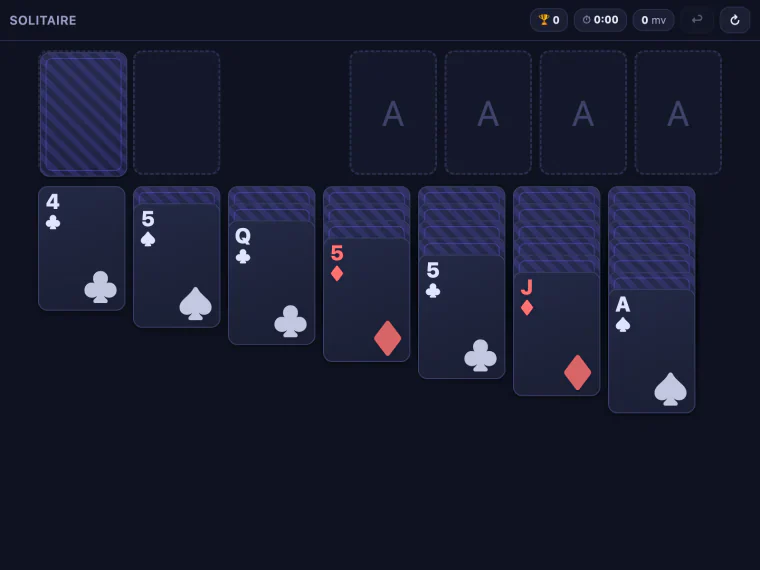
Every game of Klondike Solitaire starts the same way: 28 cards go into seven columns. Column one gets one card, column seven gets seven, and only the bottom card of each column is face up. That leaves 21 cards hidden in the tableau and 24 cards in the stock at the top left.
Your job is to build four foundation piles, one per suit, from Ace up to King. In the tableau you build down in alternating colours: a black 9 goes on a red 10, a red 8 goes on that black 9. You can move a whole face-up run at once, so if you have red 10, black 9, red 8 stacked together, you can carry all three onto any black Jack.
This version deals Draw 1. Tap the stock and one card flips to the waste pile; only its top card is playable. When the stock runs dry, tap the empty spot and the whole waste turns back over into a fresh stock. There is no limit on how many times you can go through the deck, and recycling costs you nothing.
A worked opening
Say your seven face-up cards read: 4 of hearts, Jack of spades, 7 of clubs, 10 of diamonds, Ace of clubs, 6 of diamonds, 3 of spades. What do you do first?
Double-tap the Ace of clubs to send it home. That earns 10 points and flips the card under it for another 5. Next, the 6 of diamonds can sit on the 7 of clubs, which turns over a card in column six (5 more points). The 10 of diamonds can go on the Jack of spades and uncovers a card in column four. Only after every tableau move is used up should you start drawing from the stock. Three moves in, you have 25 points and three new cards to look at, without touching the stock once.
Scoring, with the real numbers
Points here reward progress, not busywork. Moving cards between tableau columns scores nothing on its own. What counts:
- Card to a foundation: +10
- Turning over a face-down tableau card: +5
- Waste card played onto the tableau: +5
- Pulling a card back off a foundation onto the tableau: -15
- Drawing, recycling the stock and undo: no penalty (undo simply restores the score you had before that move)
What the numbers tell you
Do the maths: the 52 foundation cards are worth 520 and the 21 flips another 105, so a win with no penalties starts from 625. The variable part is the waste bonus: every stock card you route through the tableau before it goes home adds 5, up to 120 more. That puts the ceiling for a clean win at about 745 points, and each -15 for pulling a card back off a foundation comes out of that.
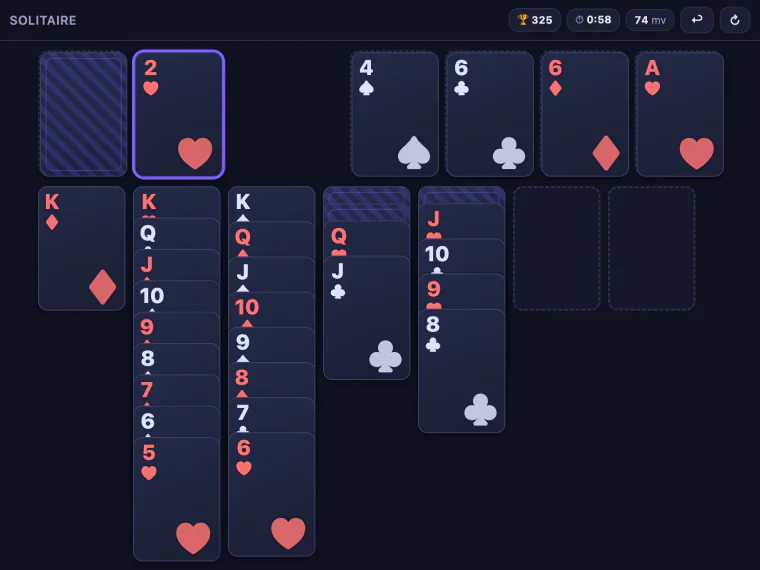
The game sets no hard cap (shuffling an Ace between empty foundation slots keeps adding 10), but in honest play the high-score move is to put waste cards into the tableau when it is safe, rather than straight onto the foundations. A waste 2 of hearts sent home scores 10; the same card parked on a black 3 first and then sent home scores 15. The score never drops below zero, and your best is saved on this device. There is no time bonus, so the clock is for bragging rights only.
Mistakes that quietly lose games
Most losses come from habits that look harmless at the time:
- Emptying a column with no King ready. Only a King can move into an empty column, so a gap with no King to fill it is wasted.
- Grabbing the first King for a gap. If you have a red Queen showing, move in the black King so the Queen has a home.
- Burying a needed card. Covering a 4 you will need for a foundation behind a long run can lock up a whole suit.
- Racing one suit home. If the 5 of spades goes up early, you lose it as a parking spot for a red 4 later. Keep foundations roughly level.
- Drawing before you look. Every tableau move you skip is a hidden card you did not turn over.
Thinking like a stronger player
When two moves look equal, pick the one that frees a card from the column with more cards face down. Column seven starts with six hidden cards; it is the biggest locked box on the board.
Watch for twins. With two black 7s in play, a red 6 has two possible homes, so you can afford to free one 7 and keep the other as a landing spot. Track which ranks are already in the foundations: once both red 5s are home, no card will ever need a black 6 as a landing spot, so it is safe to send that 6 up.
Because recycling is free and unlimited in this version, the stock is not a timer. Cycle through it once just to see what is coming before committing to a plan, and use undo to test a line and back out. Undo is unlimited within a session; a resumed saved game keeps only the last 30 steps.
Klondike versus its cousins
Klondike is the game most people simply call solitaire, or patience in British English. It became a household name when Microsoft shipped it with Windows 3.0 in 1990. The name points to the Klondike region of Canada’s Yukon, famous for its gold rush.
Draw 3 Klondike flips three cards at a time and only the top one is playable, which makes it much harder than the Draw 1 game here. Spider uses two decks; you can build down in any suit, but only same-suit runs move together or clear off the board. FreeCell deals every card face up and gives you four spare cells, so almost every deal can be solved by careful planning. Klondike sits in the middle: part planning, part luck of the hidden cards.
Klondike Solitaire FAQ
Is every Klondike deal winnable?
No. A small share of deals are stuck from the first move, and some winnable ones need perfect knowledge of where the hidden cards are. Computer studies suggest most Draw 1 deals can be won with perfect play, but real players win far fewer because the face-down cards are a mystery. Free recycling and undo here push your odds up a lot.
What do A, J, Q and K stand for in solitaire?
Ace, Jack, Queen and King. The Ace is the lowest card (rank 1) and starts each foundation; the King is rank 13 and is the only card allowed into an empty column.
Can I put any card in an empty column?
Only a King, either on its own or with a face-up run built below it. Any other card dropped there will not stick.
Is this Draw 1 or Draw 3?
Draw 1. Each tap of the stock turns over one card, and you can go through the stock as many times as you like.
Why did my score go down?
You moved a card from a foundation back to the tableau, which takes off 15 points (or whatever you had, if you had fewer than 15, because the score never goes below zero). It can be worth it to unblock a column, but it is never free.
What does the Auto-finish button do?
It appears once the stock and waste are empty and every tableau card is face up. Tap it and the game plays all remaining cards to the foundations for you, still scoring 10 points each.