💡 Echo Pads
🕹️ Arcade · 55 playsEcho Pads
Watch the lights, repeat the pattern, hold on as it grows.
About Echo Pads
Four coloured pads, one growing pattern. The pads flash a sequence; you tap it back. Get it right and the sequence grows by one and gets a little faster. One wrong tap and the round is over. With sound on, each pad has its own note, which is a real help once the pattern gets long.
How to Play
Press Play and watch the pads light up. Repeat the sequence by tapping the pads in order. Each round adds one more step. One mistake ends the run.
💡 Tips & Strategy
Sound on. Each pad has its own note, and a tune is far easier to remember than a list of colours.
Group the sequence into chunks of three or four, the way you would remember a phone number, and rehearse the chunk while the next one plays.
Don't rush the early rounds. Playing slowly and correctly builds the pattern in your head for when it gets long.
How a round actually plays out
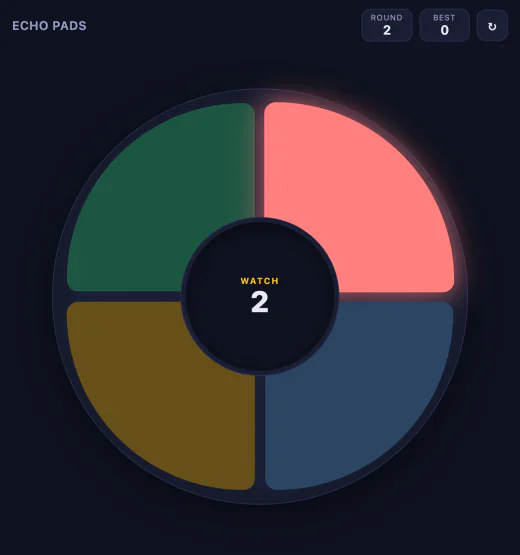
Echo Pads has four pads arranged in a ring: green top left, red top right, yellow bottom left and blue bottom right. Press Play and the hub in the middle reads Watch. After a short pause the pads flash the sequence. While that is happening your taps are ignored, so there is no way to jump in early. When the hub switches to Your turn, you tap the whole sequence back from the very first step.
Here is a worked example. Round 1 flashes red. You tap red, the hub says Nice!, and round 2 replays red and then adds one new step, say blue. You tap red, blue. Round 3 replays red, blue and adds another, maybe blue again. The old steps never change; only one new step is tacked on the end each time. That is the single most useful fact in the game: everything you memorised last round is still valid.
Each new step is picked at random from all four pads, so there is a 1 in 4 chance it matches the step before it. Doubles like blue, blue and even triples are normal, not a glitch. Expect roughly one double for every four steps you add.
The speed curve, in milliseconds
The game speeds up in blocks of four rounds. In rounds 1 to 4 each pad stays lit for 420 ms with a 240 ms gap, so one step takes about two thirds of a second. Every four rounds the light time drops by 45 ms and the gap by 26 ms.
By rounds 9 to 12 a step takes about 0.52 seconds. By rounds 17 to 20 it is about 0.38 seconds. From round 25 onward it bottoms out at 190 ms lit plus a 110 ms gap, so 0.3 seconds per step, and it never gets faster than that. Past round 25 the challenge is purely length, not speed.
Do the sums and a round-20 playback takes roughly 7.5 seconds to watch. That is where most runs die: not on the newest step, but on remembering steps 6 to 12 while the last few rush past.
Scoring and your best
Your score is the longest sequence you repeated without a mistake. If you clear round 9 and slip on round 10, your score is 9. The Round counter shows the length you are attempting; the Game Over screen shows what you actually completed, which is one less.
The end screen gives you a nudge based on that number: 6 or more counts as a solid run and 12 or more as impressive memory. Beat your old record and you get a new personal best instead. Your best is stored in this browser on this device, so it survives a refresh but will not follow you to another phone.
Beginner mistakes
Most short runs end for the same few reasons, and none of them are about memory.
- Panicking for speed. There is no clock on your input. You can take as long as you like between taps, so pause, replay the pattern in your head, then go.
- Tapping during playback. It does nothing, and it pulls your attention away from the steps you are meant to be watching.
- Re-memorising from scratch each round. Only the last step is new. Spend your attention on that one and on joining it to the chunk before it.
- Hitting the restart arrow out of frustration mid-run. It starts a brand new random sequence immediately, and the run you were on is gone.
- Playing muted. The pads play the notes E, C, A and a low E, which together make an A minor chord, so any order sounds like a little tune. Your ear holds a melody far longer than your eyes hold a list of colours.
Techniques that push you past round 15
Name the pads by position, not colour. Top left, top right, bottom left, bottom right can be shortened to a direction pattern like up, up, down, across, which is quicker to say silently than four colour names.
Use the keyboard on desktop. The keys 1, 2, 3 and 4 map to green, red, yellow and blue. Typing a number string feels like dialling a phone number, and you can rehearse it as digits: 2-4-4-1-3 is a lot easier to hold than red, blue, blue, green, yellow.
Rehearse during the gap. When you finish a round there is a short Nice! pause and then another before playback. Use it to repeat the full sequence to yourself once, so the replay becomes a check rather than a first look.
Treat doubles and triples as landmarks. A blue, blue, blue in the middle of a long run is an anchor you can hang the nearby steps on. Count runs of the same pad rather than seeing each flash separately.
Where the idea comes from
Echo Pads follows the classic electronic memory toy of 1978, designed by Ralph Baer and Howard Morrison. The four-colour ring and the call-and-response loop are the same idea; this version adds a speed curve that levels off at round 25 and keeps your best score on your device.
Echo Pads FAQ
Is there a time limit to repeat the pattern in Echo Pads?
No. Once the hub says Your turn, you can wait as long as you like before each tap. Only the playback speeds up; your input is never timed.
Does the pattern change every round?
No. The sequence keeps every step from earlier rounds and adds exactly one random step at the end. Only a new game, or the restart button, gives you a fresh sequence.
Why did my score come out one lower than the round I reached?
Your score counts sequences you completed. Reaching round 10 and missing a step means you finished 9 in a row, so 9 is your score.
Can the same colour come up twice in a row?
Yes. Every new step is picked at random from the four pads, so it matches the previous step about one time in four.
Can I play Echo Pads with a keyboard?
Yes. Press 1 for green, 2 for red, 3 for yellow and 4 for blue. Keys only register on your turn, not during playback.
What is a good score in follow-the-pattern games?
In Echo Pads, 6 is a solid run and 12 or more is strong. Getting past round 25 means holding a long sequence at the fastest playback speed, so that is a real milestone.